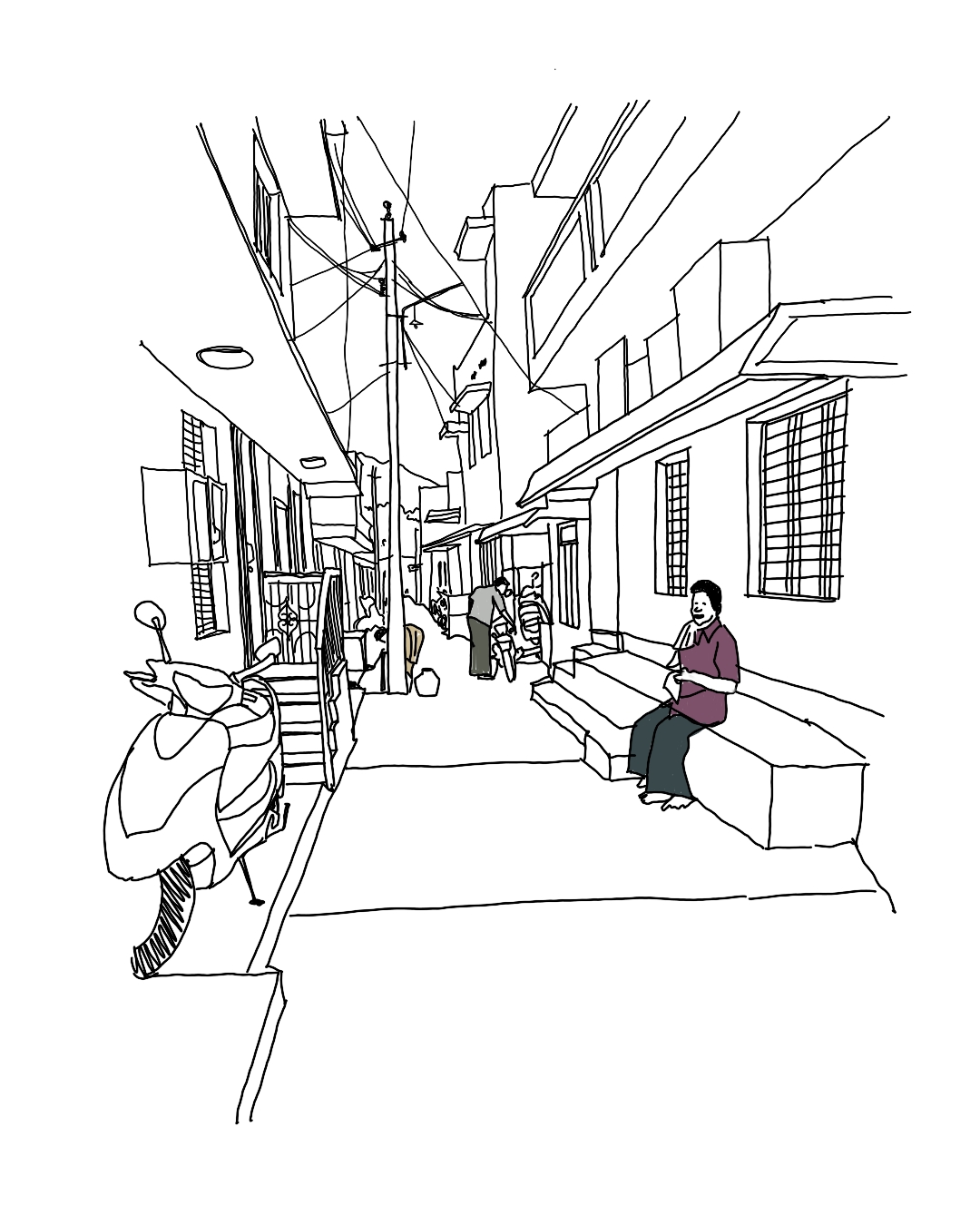
I sometimes miss the noise of my native place.
It sounds strange to say that I miss noise. But I do. I miss the mechanic shop making sounds at the corner, children shouting while playing, someone calling from one house to another, people sitting outside and talking, vessels moving, someone cleaning the front of their house. I even miss the heat.
My native place, Pattiveeranpatti in Dindigul district, Tamil Nadu, is hot, congested and noisy. It is not the kind of neighbourhood that we might immediately describe as comfortable or perfectly planned. But whenever I think about it, I remember it as cheerful. There was always something happening. Someone was always outside.
Only after studying architecture, and later moving away from my native place, did I start seeing things differently. I started wondering why that neighbourhood felt so alive. Maybe it was because of the people. But I also felt it was because of the spaces—the small spaces in between.
I grew up in a row-housing neighbourhood where we were all very well connected. People of different ages, different routines, and different ways of living. Our houses shared walls on three sides, so there was almost no possibility of having openings on the sides. At first, this sounds like a disadvantage. There were no side windows, no side garden, and no space between houses.

So naturally, we started using the frontage more. The front of the house became our breathing space. Every house had its own way of doing it. My house had only three steps and a small landing in front. Beyond that was just a plain concrete surface. Nothing special. No expensive paving, no carefully designed landscape, no particular architectural feature.
But we used that small space for so many things. We drew kolams there. We fed birds there. We dried things there. We sat there sometimes. People passed through it. Children played around it. At the right end of our house, there was a mechanic shop. So there was always some sound coming from that side. Tools, vehicles, conversations, repairs. It was noisy, but somehow that noise made the place feel occupied. It told us that someone was there.
But we used that small space for so many things. We drew kolams there. We fed birds there. We dried things there. We sat there sometimes. People passed through it. Children played around it.
My next-door neighbour had a slightly bigger set of steps with a verandah where people could sit and talk. Other houses had different kinds of front spaces. Some had bigger steps, some smaller, some had a verandah, some had only a little landing. They were all different.
But together, they created something. A continuous edge where the houses were not completely closed to the street. At that age, I never thought of these spaces as architecture. They were just there. And maybe that is why they worked. Our house also had a sit-out corridor just after entering the main door. It was not completely visible from outside because we had screening nets on the windows to avoid direct visual exposure. But from inside, we could still sit and watch what was happening outside.
We could see people. We could see children playing. We could see someone walking past. We could hear conversations.
We were inside, but somehow we were still part of what was happening outside. There was privacy, but it was not complete isolation. Looking back now, I feel that these spaces were quietly teaching us how to live with other people.
We were inside, but somehow we were still part of what was happening outside. There was privacy, but it was not complete isolation.
The three steps were not just steps. The concrete floor was not just a leftover surface. The verandah was not just an extension. They were places where people could simply be. Nobody had to plan a meeting. Nobody had to say, “Let us go and interact with the community.” It happened naturally.
Someone would sit outside. Someone else would stop. Children would play. Adults would watch them. Someone would eat something while sitting there. Someone would talk about something that happened that day. And slowly, without us noticing, we knew each other.
Even the spaces that were not meant for socialising became part of our childhood.
Under the entry steps of our houses, there was a water tank. We would close that space and sit there and play. It was never designed as a play space. It was simply a space that we found and made ours.
That is something I think about now as an architecture student and as someone who observes spaces differently. Architects give a space a function. But people give it a life.

A staircase can become a seat. A concrete patch can become a place for a kolam. A corner can become a hiding place. A street can become a playground. A water-tank enclosure can become a childhood room. Maybe the most important spaces are not always the ones with the most carefully defined function.
Maybe they are the spaces that allow us to decide what to do with them. I think this became most visible during Pongal. During celebrations, our whole street would change. We would clean the street and decorate it. Every threshold would have a colourful kolam. We would sit outside, talk, eat, watch the children playing and organise games. Everyone would take some responsibility for the street.
It was not just one house celebrating. The whole neighbourhood was celebrating. The front of every house became part of the same picture. The concrete surfaces that were used every day suddenly became filled with people. The street became almost like an extension of all our houses together. And the kolams were not just decorations. We would look at each other’s kolams. Someone from another street could come in and stop to see them. They might say something about how beautiful a particular kolam was. They might comment on it and move on. But that small interaction mattered.
The kolam became a way of communicating. It was something personal, because every house made its own design. But at the same time, it was collective because everyone was participating in the same celebration.
Even keeping the frontage clean became a shared responsibility. We cleaned, decorated. We gave food and water to birds. We looked after the street. As children, I don’t think we understood what we were learning through all this. But now I feel that the space was teaching us something.
It was teaching us to take responsibility for something beyond our own front door. It was teaching us that the street belonged to us too. It was teaching us to notice other people. It was teaching us to celebrate with others.
And maybe this is where the idea of neighbourhood begins.

Not in a large community hall. Not necessarily in a landscaped plaza. But in these small everyday moments. The space between the house and the street. The place where someone sits. The place where someone stops, where children play and neighbours becomes familiar. I only started understanding this after moving away. The neighbourhood where I live now is very different.
Most houses are gated. There is a stronger separation between one house and another. There is more privacy and controlled access. People have their own spaces and interactions mostly happen within the house.
Sometimes I realise that I have no idea who lives next to us.
I may see them occasionally when I go to the terrace. Sometimes someone from the neighbouring building comes up to dry clothes. For a few minutes, we saw each other.
But that’s it.
We know that the other person exists.
But we don’t really know each other.
There are common connectors. Temples and shops are places where we meet and greet people. So it is not that there is no community.
In my native place, interaction happened while doing ordinary things.
Here, interaction often happens when we go somewhere. That difference is very small when we describe it.
But when we live it, it feels very different.
I miss the vibe of my native place.
And I find it interesting that I miss it even though I know all its problems.
It is hot.
It is congested.
It is noisy.
The streets can feel crowded.
But there is vibrancy.
There is always somebody around.
And maybe I miss that feeling more than I miss the physical place itself.
I miss being surrounded by the everyday lives of people I know.
This made me question what we are actually trying to achieve when we design neighbourhoods today.
We have become very good at providing comfort.
We have technology.
We have better security.
We have controlled access.
We have parking.
We have beautiful materials.
We have landscaped spaces.
We have aesthetically pleasing houses and carefully designed developments.
But somewhere in all this, are we also designing away the possibility of casually meeting one another?
Are we making everything so private that we no longer know who lives beside us?
Are we making our streets only for movement?
Are our terraces becoming service spaces instead of places where people can connect?
Are our front setbacks becoming parking areas instead of places where people can sit?
And when we design a “community space”, are we actually creating community, or are we simply creating a space labelled as one?
I don’t think the answer is to go back.
I don’t want to go back to a life without the conveniences and technological advancements we have today. I don’t want to ignore the importance of privacy, security or comfort.
But I do feel that we are missing something.
We should be able to have modern amenities and still have these subtle spaces.
We should be able to have privacy without completely isolating ourselves.
We should be able to have security without closing everything behind gates.
We should be able to have beautiful architecture without making it so perfect that there is no room left for people to use it in their own ways.
Because sometimes the things that make a place feel alive are not the things we intentionally design.
A chair pulled outside the house.
Clothes drying on a terrace.
A child sitting on the steps.
Someone feeding birds.
A kolam slowly fading because people are walking over it.
A mechanic shop filling the street with sound.
Someone sitting outside and watching children play.
These things may not appear in a perfect architectural photograph.
But they tell us that the space is being lived in.
They are traces of people.
They are traces of culture.
They are traces of relationships.
Maybe this is why I feel that a healthy neighbourhood should have different age groups and different kinds of people living together. It should have residential spaces mixed with small shops, commercial activities and social infrastructure. It should have vegetation and comfortable pedestrian movement. It should have open spaces, but not only one large open space that everyone is expected to use.
It should have many smaller spaces.
Different sizes. Different levels of privacy. Different degrees of openness.
Steps. Verandahs. Shaded edges. Small courtyards. Shared terraces. Street corners.

Places where someone can sit for five minutes without having a reason.
These spaces don’t have to be spectacular. They just have to allow interaction to happen.
Maybe we should design neighbourhoods where people can see each other without feeling watched, where children can play while adults are nearby, where elderly people can sit outside, where different generations can naturally occupy the same spaces, and where festivals and everyday activities can spill into the neighbourhood. Technology can help us with comfort and amenities.
Maybe we should design neighbourhoods where people can see each other without feeling watched, where children can play while adults are nearby, where elderly people can sit outside, where different generations can naturally occupy the same spaces, and where festivals and everyday activities can spill into the neighbourhood.
Architecture can help us with the spaces. But the human connection still has to happen between them. I used to think my native neighbourhood was connected because we were already a community.
Now I wonder if we became a community because the neighbourhood gave us so many small opportunities to be together.
The shared walls restricted our houses, but the frontages opened them. The three steps became a place to sit. The concrete became a place for kolam. The water-tank space became a place to play. The verandah became a place to talk. The terrace connected us. The street became a place to celebrate. None of these spaces were extraordinary. Maybe that is exactly why they mattered.
They were ordinary. They were open to use, open to people, open to change. And they quietly held our everyday lives. Perhaps the spaces we are missing today are not always large public spaces or grand architectural gestures. They are the subtle spaces in between. The spaces that don’t ask us to do anything. The spaces that simply give us a reason to pause.
To see someone. To say something. To sit, watch, play, celebrate. To belong.
I still remember the heat, congestion and noise of Pattiveeranpatti. But now, when I think of that noise, I don’t hear it as a problem. I hear children playing. I hear the mechanic working. I hear neighbours talking. I hear someone calling from one house to another. I hear a neighbourhood alive with people. And maybe that is what architecture should not forget. We don’t always need more space. Sometimes we simply need spaces that make room for us to be human with one another.
…maybe that is what architecture should not forget. We don’t always need more space. Sometimes we simply need spaces that make room for us to be human with one another.